Marco Baldini
Fortunale
There is humble generosity to Marco Baldini's work: a mirror for an artist whose passion for music compels him to quickly point toward the work of others, while acknowledging the discrete influences of everyday life. Active within Italy's experimental community for years, Baldini's work as composer has quietly emerged into the public consciousness over the last three years, capturing the hearts of those lucky enough to have crossed its path. Fortunale, composed between 2024 and 2025 and performed by the acclaimed, Turin-based ensemble, Quartetto Maurice - Georgia Privitera (violin), Laura Bertolino (violin), Francesco Vernero (viola), and Aline Privitera (cello) - is the latest to join the remarkable, growing body of work under his own name: an effort of minimalist restraint that defies the tropes commonly associated with that term, revealing a singular sensibility and vision - tense and complex in the multiplicity of its conjunctions - that unfolds as an enduringly warm embrace. It is a work threaded with diverse references, touchstones, and homages that consciously bind it within layers of sonic conversance that transcends the boundaries of temporality, direct association, culture, and place: speaking to something more fundamental and human about the relational self and our desire to join an unending continuum and communicate through sound.
Born in 1986 and raised in a small town in the countryside near Florence, Marco Baldini's biography - made up of slim fragments of detail - reads as a constellation of nodes through which very little is explicitly stated, but a great deal is implied: his studies of archeology and music pointing toward a particular relationship to the past, allowing for its place in the present; his work with Tempo Reale - the experimental music center founded by the composer Luciano Berio - as an editor of its publication, Musica Elettronica, and as a concert curator, speaking to dedication and support of his creative context that extends far beyond his musical contributions to it; his day job as a librarian alluding to a relational quietude amongst the archives of cultural accomplishment; and his longstanding studies of the North Indian, Hindustani classical traditions of Dhrupad and Khayal, suggesting an openness and breadth of inquiry that is reasonably rare. Drawing upon a longstanding love of jazz and free improvisation, Baldini first came to note as a member of the ensemble, Blutwurst, cofounded with Daniela Fantechi and Edoardo Ricci in 2011. Over the subsequent years, he has doubled his efforts on trumpet (both within and outside of that project), helping to realize a diverse range of works by, or made in collaboration with, Tomaga, Philip Corner, Emmanuel Holterbach, Laurent Peter and Cyril Bondi, Marja Ahti, and Nicolas Remondino. Baldini's work as a composer began in 2020, responding to chance and circumstance, when he was afforded a new sense of time, space, and solitude by the pandemic lockdowns of that period. Over the ensuing six years, he has produced a striking body of chamber compositions for acoustic instrumentation, each work defined by subtle harmonic tension and shifting palettes of durational timbre and tone, revealing a remarkably generous spirit, that consistently encounters Baldini pointing toward fellow travelers within the expansive histories of music to which he belongs.
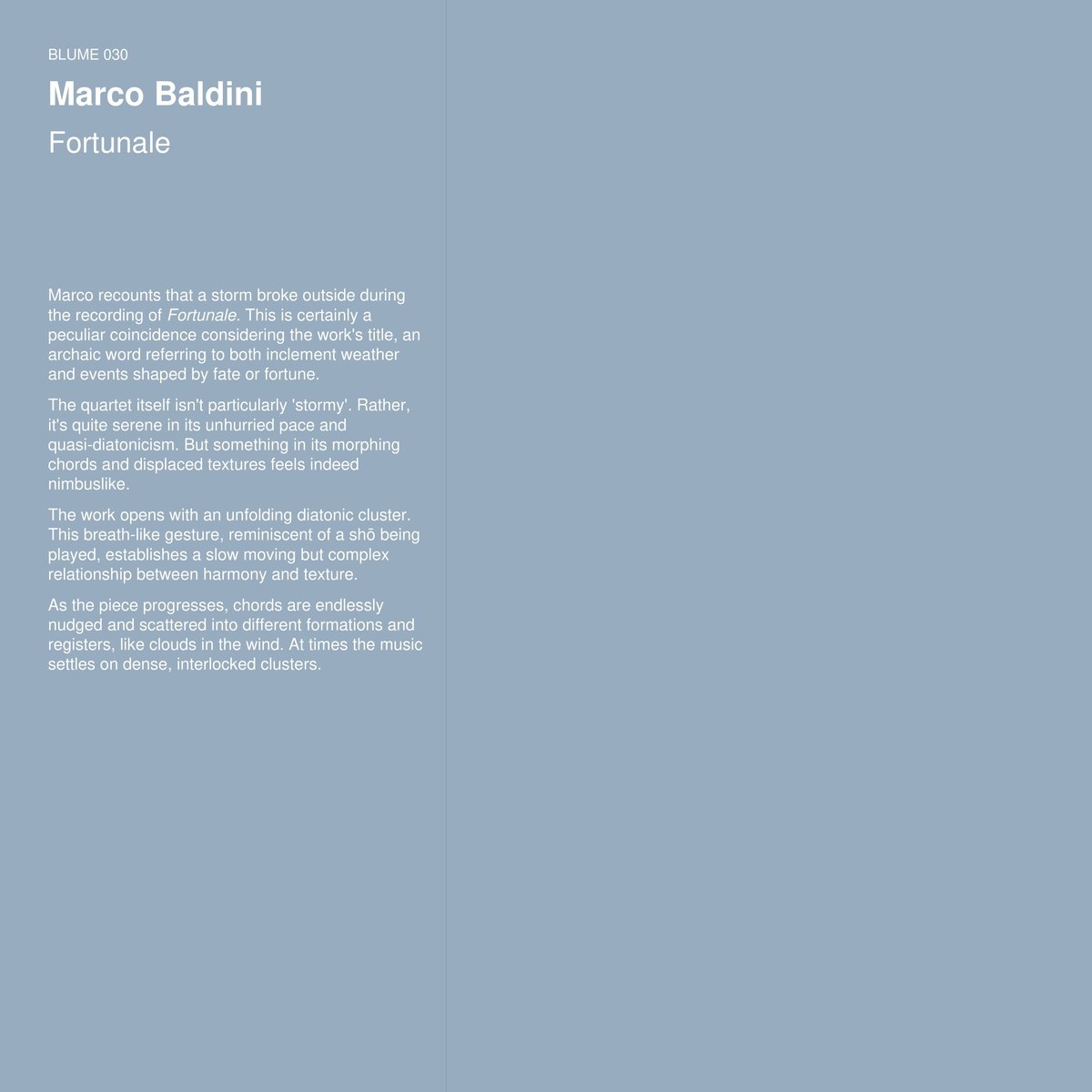
Performed by Quartetto Maurice and recorded by Manuel Volpe during the autumn of 2025 at his studio on the Dora river in Rivoli municipality of Turin, Fortunale is the product of a long period of gestation and transformation - instigated by numerous shifts and changes in Baldini's life, nested within a quiet period during which few other creative distractions appeared - from its original conception as a duo for violin and viola in 2024, to its final commitment to tape as a quartet for two violins, viola, and cello. The piece's title is an archaic Italian word that indicates an event brought about by chance, but has longstanding usage to refer to a violent storm. Inspired by Renaissance and Baroque imagery, as well as the representation of storms and natural events in early music, Baldini embraced the multiplicity of meanings implied by the word - allowing for interpretation on the part of the ensemble, as well as the incorporation of the sounds of a storm that, by chance rather than design, permeated the walls of the studio during the piece's recording - while interpreting it with a poetic sensibility: "I was drawn to the idea of a kind of premonition, and to those subtle signs in nature that something is about to change: shadows growing longer, or the sky slowly darkening."
Comprising seven seamlessly merging sections over its roughly 38-minute duration, Fortunale is remarkably emotive and imagistic for a work so firmly rooted in the abstract realm: a glacial lament, punctuated by hanging rests, that internalizes its composer's references, touchstones, and homages - Medieval, Renaissance, and early Baroque music; quotations of Béla Bartók's Fourth String Quartet and Third Piano Concerto; and the Japanese tradition of shō (mouth organ) playing; as well as spectralist nods; and the deeper meanings, accessed through harmonics, drawn from Baldini's studies of Dhrupad - so completely, that the piece almost entirely defies clear association to musical era and idiom, becoming both timeless and polycultural, while remaining highly specific and singular. Like much Indian classical music, or Harley Gaber's attempts to produce a spectral music that operates as nature does, Fortunale points to extra-musical phenomena as a conceptual underpinning - guiding its structure and sonic relationships - be that simple, unpredictable chance, or the movements of the natural world, without forgoing a clear relationship to musical materiality and history. It is a maze-like network and a tie that binds.
As violin, viola, and cello move in shifting tides across these two sides - often performing feats of sonic alchemy that can easily allow the quartet to be mistaken for a single harmonium or shō - Fortunale emerges as a work of profound beauty and grace: each timbre and tone distilled to the elemental, generous and poetic, transmogrifying Baldini's many touchstones, drawn from across history and his own experiences, into something quietly radical, unpredictable, and new.
- Fortunale (Part I)20:08
- Fortunale (Part II)18:00
Quartetto Maurice: Georgia Privitera - violin, Laura Bertolino - violin, Francesco Vernero - viola, Aline Privitera - cello
Recorded by Manuel Volpe at Okum Studio, Rivoli, Turin, 23 October 2025
Mixed by Francesco Toninelli
Mastering by Andrea Marutti
Liner notes: James Rushford & Bradford Bailey
℗ & © SIAE - Blume 030 - 2026